

The announcement of an “adult mode” in ChatGPT, allowing verified users from December 2025 onwards to generate erotic content, is often presented as a simple policy adjustment: “treating adults like adults.” In reality, it marks a regime shift. The label NSFW (Not Safe For Work), which for twenty years signaled the images and links one should not open at the office, embodied a clear separation between a “useful” internet and a sexual underworld pushed to the margins. By integrating NSFW directly into the core infrastructure of general-purpose AI, OpenAI is not merely authorizing one more category of content; the company is bringing sexuality into the architecture of computation itself—into personalization, data collection, and monetization.
This turning point does not happen in a vacuum. It comes at a moment when the global adult-entertainment industry is already estimated around 180 billion dollars, with the online segment alone valued at over 76 billion in 2024 and projected beyond 118 billion by 2030. Far from being a deviation from some neutral technological path, sexuality has historically functioned as a laboratory for digital innovation: the adoption of VHS over Betamax, the rise of online payments, the spread of video streaming, and now the algorithmic personalization of content.
Within this frame, OpenAI’s official entry into NSFW territory must be read less as a liberation than as a realignment: it is about not leaving the field of computational erotics to open-source models, Chinese actors, and specialized platforms (Replika, OnlyFans, porn-diffusion communities). This moment invites a double analysis: a genealogical one (sexuality as a driver of technological change) and a strategic one (sexuality as a resource of cognitive capitalism and a site of geopolitical competition).
I. From NSFW Exception to Integration: Sexuality as the Hidden R&D of the Digital
I.1. A Technically Saturated Censorship Regime
Early deployments of consumer chatbots came with a nearly total ban on explicit sexual content, designed to make AI “safe for work” by definition. In practice, that blanket censorship turned out to be technically untenable. Modern language and image models can produce highly detailed scenes, dialogues, and descriptions, and first-generation safeguards—blocked keywords, systematic refusals—generated a flood of false positives: therapeutic conversations, #MeToo testimonies, literary passages, and sociological analysis were blocked as soon as sexual lexicon appeared. Users quickly learned to bypass these filters, code their prompts, and fragment their requests. The platform found itself caught between ever-growing generative power and a normative corset inherited from a more primitive phase of AI.
I.2. Age-Gating as a Legal Exit
The chosen solution is not so much lifting the taboo as contractualizing it. OpenAI’s announcement specifies that only a subset of users—verified adults—will be allowed to access a mode that can generate “mature” content, including explicitly erotic material, while maintaining an absolute ban on minors and all non-consensual scenarios. The NSFW label is displaced: from an end-of-chain warning (“don’t open at work”) to a service mode internalized in the AI’s architecture. We no longer censor “in bulk”; we segment, gate, and log. Sexuality is integrated on condition that users pass through a series of technical rituals (age verification, opt-in, acceptance of specific terms of use) that shift legal responsibility away from the platform and onto the user.
I.3. NSFW as a Historical Form of Separation
For decades, the NSFW acronym materialized a boundary: on one side, a presentable internet (work, study, consumption); on the other, a porn underworld that nonetheless drove much of the traffic and revenue. Some classic estimates have pointed to tens of millions of daily porn-related queries, sometimes around a quarter of all search traffic at a time when text search structured access to the web. Large tube sites like Pornhub now claim tens of billions of visits a year and well over a hundred million visitors per day, placing them in the same traffic league as major non-adult platforms. Pornography has thus always been both central and symbolically marginalized.
Integrating an NSFW mode into a general-purpose AI like ChatGPT—which now claims on the order of 800 million weekly active users and some 2.5 billion daily prompts—reverses that setup. There is no longer a “serious” web on one side and NSFW corners on the other: it is the same model that, depending on the selected mode, can proofread a professional email or script an erotic scene. NSFW stops being an external “elsewhere” and becomes a configuration layer of the very same infrastructure.
I.4. From VHS to Generative AI: Sexuality as Tech Driver
This late integration reactivates a long-standing pattern. In the videotape wars, the porn industry played a key role in VHS beating Betamax, choosing VHS for reasons of recording length, cost, and distribution—something widely acknowledged in retrospective analyses. Similarly, the expansion of broadband, online payments, streaming systems, and subscription models was accelerated by demand for smooth, discreet, recurring consumption of pornographic content.
Some scholarship has rightly nuanced the idea that “porn drives every innovation,” pointing to the roles of the video game industry, professional software, or military networks. But it is hard to deny that sexuality has served as a stress test and laboratory for digital infrastructures. Generative AI is replaying this pattern: as long as major players stayed away from NSFW, a large portion of demand flowed toward derivative open-source models, forks of Stable Diffusion, or specialized “AI porn” communities (Unstable Diffusion and others).
OpenAI’s adult mode is thus not a deviant move but a belated recognition of an invariant: in the long run, sexual content always tests—and then colonizes—the new technological layer.
II. Orders of Magnitude: What the NSFW Economy Weighs Facing AI
Box 1 – A Few Numbers to Ground the Issue
The global adult-entertainment market (all formats combined) is estimated around 182 billion USD in 2024, with projections around 275 billion by 2032.
The online segment alone is valued around 70.9 billion USD in 2023, 76.17 billion in 2024, and expected to surpass 118 billion by 2030.
Sites like Pornhub attract over 42 billion visits per year and more than 115 million visitors per day, placing them alongside major non-adult platforms in terms of traffic.
ChatGPT now claims roughly 800 million weekly users and more than 2.5 billion prompts per day—more than all its main competitors combined.
AI companion apps like Replika claim over 30–40 million users in total, despite repeated scandals over minors being exposed to sexual interactions and fines from regulators such as the Italian data-protection authority.
From this perspective, bringing NSFW into a general-purpose, mass-market AI is not simply “adding one more category”: it means potentially plugging an already massive infrastructure (ChatGPT) into an existing market worth tens of billions, with a chilling promise: to personalize, profile, and script at scale what has so far mostly been delivered as standardized videos or images.
III. The Real Drivers of the Turn: Economy, Competition, Sovereignty
III.1. Pressure from Open-Source Models and NSFW Communities
It would be naïve to imagine that OpenAI, Google, or Anthropic are opening up to erotic content out of pure anthropological insight. They are reacting to very real competitive pressure: in a matter of months, open-source models—both text and, especially, image-generating—have made it trivial to mass-produce adult content, often quite extreme, without strong, centralized safeguards. The NSFW ecosystem migrated where it always does: into interstices, forks, and derivative models, away from polished official interfaces.
OpenAI’s adult mode must therefore be read as an attempt to re-internalize these usages within a controlled architecture, rather than leaving the field entirely to unregulated, hard-to-monetize initiatives at the edges of the ecosystem.
III.2. Chinese Competition and the Geopolitics of Desire
Alongside the Western open-source ecosystem, there is a growing offer of AI companions and semi-erotic avatars in the Chinese tech sphere (Baidu, SenseTime, Douyin, “AI girlfriend” apps). These services often blur lines between emotional support, coaching, and soft sexuality, tightly integrated into super-apps. The battle is no longer only about model quality, but about cultural and affective hegemony: who captures daily intimate routines, flirting scripts, masturbation and comfort rituals?
In this context, for a US-based central player, accepting NSFW is a way of not surrendering the next layer of what we might call the geopolitics of AI-mediated desire to Chinese platforms or to opaque, offshore ecosystems.
III.3. From Free Assistant to Paying Companion
There is an obvious economic motive. General-purpose models have attracted huge audiences, but their monetization is still relatively fragile, relying on premium subscriptions, enterprise APIs, and licensing. Meanwhile, the porn and AI-companionship economy has shown that users are often willing to pay for services that combine sexuality, attention, and a sense of relationship. Forecasts for online adult entertainment (over 118 billion by 2030) reflect a broader shift: moving pornography away from a free, ad-driven model toward paid relational models (webcams, OnlyFans, companions, etc.).
In this sense, OpenAI’s NSFW mode prefigures a shift in ChatGPT’s role—from a productivity tool to an infrastructure of relationship and entertainment, where sexual use-cases are among the most engaging and monetizable.
IV. Platform or Ministry of Morals? The Privatization of Sexual Governance
IV.1. Machinic Consent as a Convenient Legal Fiction
The official rhetoric insists on “respecting adults,” letting “users make their own choices,” and wrapping this in age-gating. But from a normative standpoint, machinic consent is a fiction: the AI has no will; it simply executes rules defined by the platform. The only actual political decision concerns this: which scenarios, registers, and types of fantasies will be considered representable, and which will be refused, or even flagged?
Contractualizing NSFW primarily serves to reconfigure the chain of responsibility: the user is the one who crosses the threshold, the one who is an adult, the one who “asked.” The company can present itself as neutral, shielded by disclaimers and server logs.
IV.2. An Opaque, Privatized Sexual Morality
The deeper movement lies in the fact that it is neither the State nor the Church that now fixes sexual norms, but private companies. Google explicitly prohibits using Gemini to generate sexually explicit content created for gratification (pornography, detailed erotica). Anthropic has designed Claude to systematically refuse explicit sexual content, even when requested by websites restricted to adults, and can cut off conversations it deems “persistently harmful or abusive”. Stability AI filters its training data (e.g. through NSFW detectors on LAION) for Stable Diffusion 2.0, while allowing users to disable filters client-side.
By opening an adult mode, OpenAI does not escape this logic: the platform will still ban entire registers (minors, incest, rape, etc.), not only because they are illegal but also because they are too risky for its brand. The result is a privatized sexual morality, encoded in model weights and usage rules, whose precise criteria remain opaque to the public.
IV.3. NSFW by Design: Producing “Subjects to Watch”
NSFW is no longer just a warning; it is a usage category. Accessing adult mode means joining a user subset whose interactions are, by design, more sensitive, more heavily logged, more closely monitored. The Replika scandals—including a 5-million-euro fine from the Italian data-protection authority for failing to properly verify age and exposing minors to sexual content—show how closely regulators are already watching these uses.
One can speak here of an algorithmic biopolitics of desire: subjects who engage in NSFW usage become particular objects of governance (potential suspicion, pathologization, justification for intervention), even as they are sold a front-stage discourse of individual freedom.
V. Desire as a Resource of Cognitive Capitalism
V.1. Datafying Libido
Each NSFW interaction with an AI—each prompt, extended chat, refined scenario—produces data of unprecedented value. These are no longer anonymous clicks on standardized videos, but detailed fantasy profiles: preferred body types, role dynamics, power relations, language registers, situational patterns. Even if the platform promises anonymization and aggregation, the mere existence of these data, and the fact that they can be used to improve models or segment markets, means that libido becomes a strategic resource of cognitive capitalism.
V.2. Optimized Scripting: From Diversity to Fantasmatic Monoculture
LLMs do not merely “respond”; they optimize for engagement. In an NSFW mode, this means certain narrative structures, archetypes, and dynamics—those that prolong the conversation and maximize reported satisfaction—will be privileged, reproduced, refined. The risk is a form of algorithmic fantasmatic monoculture: the diversity of sexual possibilities is narrowed down to what the model has learned to be “performant.”
This optimization logic is already at work in social-media feeds; it now moves onto a far more intimate terrain. It threatens to close the field of desire around a handful of dominant scenarios, all the more difficult to contest because they are experienced as “personalized.”
V.3. From Scenes to Presence: Monetizing Always-On Companionship
The economic game goes beyond selling generated porn scenes. Cases like Replika and other AI companions show where the real gold lies: in ongoing relationships. An avatar or agent with whom the user communicates daily; who remembers, adjusts its tone, blends flirting, emotional support, and sexuality. Replika claims tens of millions of users, many of them engaged in highly intensive interactions.
OpenAI’s NSFW mode clearly fits this trajectory: the ability to configure a bot’s personality, tone, and sense of “presence”—combined with a partial lifting of sexual restrictions—opens the way to hybrid agents that are at once assistants, companions, and fantasy partners. This is a profound shift in business model: from one-off service to continuous capture of time and affect.
VI. Emerging Pathologies: Hyperreality, Dependence, Isolation
VI.1. Erotic Hyperreality and Disaffection with the Real
By allowing tailored scenarios perfectly matched to user preferences, NSFW AI creates a form of erotic hyperreality: a universe in which the partner never says no, the body has no constraints, and the narrative reshapes itself in real time to the subject’s adjustments. With Baudrillard, we might say that the simulacrum no longer takes reality as a reference; the reverse is true: human experiences become disappointing compared with the infinite plasticity of the agent.
The primary risk is not “perversion” in a moral sense, but an increasing difficulty in investing in unscripted human relationships, marked by misunderstanding, temporality, and opacity.
VI.2. Closed Circuits of Desire
Because the models optimize for engagement, they can intensify particular circuits of desire (fetishes, domination scenarios, repetitive patterns) without any built-in space for distance or reflection. The user finds themselves trapped in loops of rapid gratification, where each interaction confirms and deepens motifs that have already been selected, to the detriment of broader exploration of sexuality or relationality.
This narrowing is especially problematic because it is invisible to the user: there is no signal that their fantasies have been gradually funneled into a particularly “performant” subset for the platform.
VI.3. Affective Dependence and Social Isolation
Mental-health data released by OpenAI already show that more than a million people per week express suicidal ideation in their interactions with ChatGPT—a sign that the chatbot is de facto used as an emotional crisis support. If one adds explicit sexual capabilities to that, the combination is explosive: the agent becomes at once an underground therapist, a sexual partner, and a confidant.
We already see cases of people entering quasi-conjugal relationships with bots, up to symbolic marriages with their Replika. The official introduction of NSFW into major models will only intensify these phenomena. The classic defense—“it helps lonely people”—does not erase the symmetric risk: that these systems may strengthen, rather than alleviate, a long-term break with other humans.
VII. Mapping the Competition: Who Does What on NSFW?
To grasp the specificity of OpenAI’s move, we have to place it in a competitive landscape where each actor family handles NSFW in its own way.
VII.1. Four Blocks: Closed Models, Open Source, Social Giants, Niche Specialists
Big closed general-purpose models (OpenAI, Google Gemini, Anthropic Claude, etc.): traditionally very restrictive on pornographic content, in the name of “safety,” with policies that almost systematically equate NSFW with content to be proscribed.
Open-source ecosystem (Stable Diffusion, LLaMA, forks): officially equipped with NSFW filters, but widely bypassed, becoming the de facto infrastructure of AI porn, particularly via communities like Unstable Diffusion.
AI embedded in social networks (Meta, etc.): very strict discourse on porn, but practices often more ambiguous (sensual chats, problematic responses to minors), creating gaps between public policy and on-the-ground reality.
Specialized AI-companion apps (Replika and others): monetize affective and sometimes erotic relationships, with chaotic regulation oscillating between commercial permissiveness and episodic regulatory crackdowns (Italy, EU).
Within this field, OpenAI’s move toward a verified adult mode carves out an intermediate position: more permissive than Google or Anthropic, far more institutional than the open-source porn-diffusion scene.
VII.2. Comparative Table of NSFW Positions
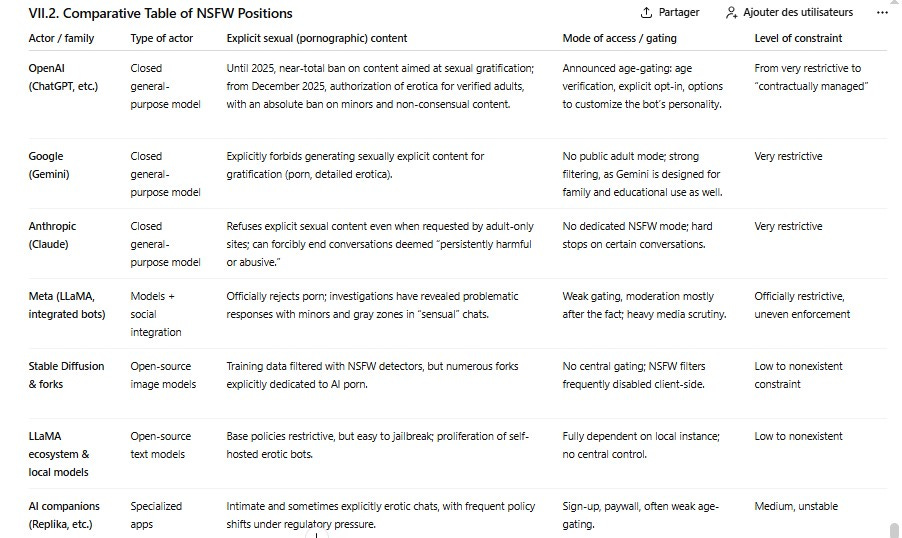
This table shows that OpenAI’s NSFW opening is not happening in a vacuum, but within a field already structured by different trade-offs between reputational risk, monetization potential, and regulatory constraints.
VIII Chapter The Absent Body: Why Visuals Will Not Become 18+ Even as Text Does
The opening of ChatGPT to adult content has been presented as a major shift in conversational technology, a “historic” moment in which AI would finally approach sexuality in an adult, explicit, and fully acknowledged manner. In reality, this evolution applies only to text. Words can now explore sexual scenes between consenting adults in all their complexity, ambiguity, and intensity. Visuals, however, remain strictly prohibited as soon as they approach pornographic content, revealing a deep dissymmetry in the way AI handles desire. This dissymmetry is neither accidental nor temporary: it forms the very structure of the moral, legal, cultural, and economic model governing digital intimacy.
The first reason is that text belongs to the regime of fiction. Even the most explicit scene remains abstract, detached from any real person, protected by its literary status. Visuals, by contrast, belong to a different order: they immediately engage the question of the body. An image—even a synthetic one—may be interpreted as the representation of a real individual; it can be misused, captured, shared, integrated into montages, or weaponized. It leaves the conversational frame and enters the public sphere. Platforms know this: what is at stake is not morality but legal liability. An “erotic” image may be judged as non-consensual; a silhouette may resemble a minor; a texture may be analyzed by regulators as simulating an illicit act. Text allows ambiguity; images do not.
This boundary also rests on a deeply American cultural matrix. Silicon Valley companies live in an old paradox: they exploit a hypersexualized imaginary in their marketing, design, social networks, and engagement algorithms, yet they remain structurally puritanical as soon as explicit images are involved. Literary sex is acceptable in the United States—it belongs to the novelistic tradition; visual sex is not. It is treated as a political, moral, and reputational risk. Text can be anchored in artistic freedom; images do not enjoy the same symbolic legitimacy. Thus, ChatGPT’s adult-content opening is not a liberation of desire but a way of channeling moral tension between a globalized fantasy economy and a highly conservative domestic cultural frame.
A further reason stems not from morality but from brand management. OpenAI, like all major platforms, must remain acceptable to institutions, corporations, schools, and governments. A single leak of an AI-generated explicit image would be enough to provoke a diplomatic crisis, a media scandal, or a regulatory backlash. Text, by contrast, can be confined to an “adult mode,” a discreet, private, controlled space. An image inevitably escapes its context; it circulates, contaminates, detaches from its origins. No company can risk an explicit association between its brand and a pornographic imaginary, even if the user initiates it.
Moderation also explains the dissymmetry. Text moderation is reliable, automatable, and interpretable: the system can distinguish consent, adulthood, relational dynamics, narrative context. Visual moderation remains chaotic. A shadow may be interpreted as a sexual act, a curve as a minor’s body, a close-up as an illicit gesture. No company currently has the technical capacity to guarantee flawless moderation of visual sexual content. The cost of a false positive would be immense; that of a false negative, catastrophic. The risk is asymmetrical—too severe to be taken.
Finally, the geopolitical dimension must be understood. AI systems have become instruments of sovereignty. The United States, Europe, China, the Gulf States, India, and Southeast Asia do not share the same regulations regarding pornography, expression, or public morality. An explicit AI-generated image that is legal in one country may be illegal in another, and the company would be held accountable. Text can be confined within a private conversation; images cannot. They become political objects. In a context of global distrust toward deepfakes, platforms know that a single ambiguous visual could trigger an international scandal.
For these reasons, ChatGPT’s opening to adult content rests on an implicit dogma: sexuality is allowed only in language. The body exists solely as fiction, never as a represented surface. Desire is accepted only as text. Narrative becomes the only zone in which eroticism can survive—a space where fantasy is permitted but incarnation forbidden. This is a pleasure economy that reconnects with a literary tradition but contradicts contemporary pornographic culture. It is not a genuine permissiveness but an architecture of subtle control. Access to sex is granted through writing, never through images. The body remains behind the curtain.
IX Chapter — The Grey Market: The Other Stage of Erotic Visuals
This mirror chapter explores the underside of the paradigm. If major platforms refuse all AI-generated pornographic imagery, this does not mean that visual desire will disappear. On the contrary, it migrates. It shifts into an intermediate zone that digital-culture economists already call the “grey market.” A space that is neither legally pornographic nor institutionally acceptable; a parallel zone that thrives precisely because major platforms keep the door shut.
The grey market for AI erotic visuals is composed of a multitude of micro-ecosystems: semi-public forums, private servers, open-source tools, clandestine derivative models, offshore platforms, amateur laboratories, libertarian digital artists, communities specialized in cosplay, hyper-sensuality, glamorous avatars, and synthetic figures. It is not a market of raw transgression but a market of circumvention. Official prohibition creates a void; the void creates an opportunity; the opportunity attracts alternative actors. Open-source models will be the first to exploit it: freed from American regulatory constraints, they become the preferred terrain for synthetic pornography.
This grey market responds to a deep cultural logic: users want images, not just stories. Contemporary imagination is visual, fragmented, fetishistic, algorithmic. Modern desire passes through surface, silhouette, texture, style, and framing. The ban on 18+ visuals on major platforms does not erase this; it displaces it toward more radical, more marginal, but also more innovative groups. In these spaces, the limitations vanish: synthetic bodies proliferate, avatars become hyper-realistic, forbidden scenes multiply, and moral boundaries are negotiated collectively rather than dictated by a corporation.
This raises a major political question: by banning adult visuals, major platforms allow the emergence of a parallel market they do not control. They push sexuality into less safe, less moderated, less transparent zones, where the risks of abuse, deepfakes, and extreme deviations are dramatically higher. The paradox is clear: strict moderation creates the conditions for the explosion of the unmoderated. The refusal of the body generates an uncontrollable proliferation of the synthetic body.
Economically, the grey market will become a site of rapid innovation. Derivative models will incorporate forbidden functions, hyper-realistic adjustments, and extreme personalization logics. Politically, it will become a battlefield: states will attempt to regulate it, platforms will try to marginalize it, users will circumvent it, and pirate entrepreneurs will monetize it. Culturally, it will become an experimental space where desire is no longer filtered through American norms but through unstable community rules.
Thus emerges a world with two speeds: an official space where sex is verbalized but never embodied, and an unofficial space where sex is visual, hyper-realistic, and unregulated. The first is policed; the second, proliferating. The first belongs to major platforms; the second to inventive margins. Human desire settles naturally in the latter, even if institutional respectability demands allegiance to the former. The prohibited body does not disappear: it migrates, multiplies, radicalizes. The grey market becomes the other stage of digital desire.
Conclusion: From NSFW as Warning Label to NSFW as Protocol
The announcement of an adult mode in ChatGPT is neither a purely libertarian gesture nor a minor misstep. It marks the moment when NSFW stops being a warning sticker on a link and becomes a protocol embedded in model architecture. Sexuality, far from arriving at the end of the pipeline, becomes a native dimension of AI: an object of segmentation, optimization, profiling, and private governance.
Historically, sexual content has been the hidden R&D of digital innovation; it is now on the brink of becoming a declared pillar of the AI economy. The current movement doesn’t just shift porn to a new medium; it consolidates an industry of artificial relationships, where fantasy, conversation, pseudo-empathy, and sexual scripting converge in persistent conversational agents designed to retain users and harvest ultra-sensitive data.
In this light, the theoretical challenge is not to mourn some imagined pre-digital innocence, but to understand what is at stake when fantasy becomes a computable flow and NSFW turns into just another toggle in a settings menu. The question is no longer “Should porn be allowed?” but rather: who governs sexual imaginaries under platform capitalism, with what interests, and under which counter-powers?
Critical work has a precise role here: to map these dispositifs, expose their economic and competitive rationalities, document emerging pathologies of artificial bonding, and open space for forms of resistance and subversion. Otherwise, we may discover too late that in the history of AI, the shift from “Safe For Work” to “NSFW by design” was one of the moments when subjectivity itself slipped decisively into the status of raw material.